• The positives of neuroticism

    I’m doing a ‘People and Organisations’ class this semester and in its first few weeks we have been looking closely at personality traits. This has involved doing a couple of questionnaires to determine our own personality type, including the Myer-Briggs Type Indicator (MBTI) and the five factor model, also known as the Big Five or the OCEAN model (openness, conscientiousness, extraversion, agreeableness, and neuroticism). It was no surprise to get quite a low extraversion score. I scored on the high side with openness, conscientiousness and agreeableness. On neuroticism my score was about mid-way. Tellingly perhaps, the scoring for this last trait seemed to have generated some consternation in class. I guess no-one likes the thought of being neurotic, we all aspire to being emotionally stable.

    According to Jennifer Tzeses on psycom.net neuroticism is basically how a person handles stress. She quotes clinical psychologist Kristin Naragon-Gainey who explains that neuroticism is related to the ways people experience negative emotions in response to stress – feelings like sadness, anxiety, fear, hostility, irritability and anger. Sometimes the level of emotion is disproportionate to the reality of the situation. A psychiatrist Grant H. Brenner explains how this becomes unhealthy when it “can become a ‘crash and burn’ dynamic, where negative beliefs about yourself lead to ineffective social functioning, which then confirms those negative beliefs, and further re-enforces neurotic tendencies”.

    It is a dark spiral which I’ve experienced through many years of social anxiety and depression. Cognitive therapy has helped me understand what is going on at these times and I find it a lot easier now to lift myself out of the worst of the debilitating depths in which I would dwell for weeks on end. I remember many years ago, discussing depression with a friend who was also prone to it. We agreed that while it made life utterly terrible, conversely it also brought with it an exquisite appreciation of and for life and experience. So there is an upside.

    The clinicians agree. “These personality types tend to be intelligent, humorous, have more realistic (if cynical) expectations, a greater self-awareness, drive and conscientiousness, they take fewer risks, and have a strong need to provide for others” says Dr Brenner. According to research, neurotic people are more likely to be creative thinkers and possess more emotional depth. “They have more experience handling negative emotions, which, though difficult, can also make them deeper, and facilitate empathy and understanding for other people’s struggles” explains Dr Naragon-Gainey.

    They suggest some simple techniques to help shift a negative mindset:

    • Be mindful
    • Take some deep breaths
    • Practice self-acceptance

    From “What Being Neurotic Really Means” by Jennifer Tzeses, accessed 22/06/2022 from https://www.psycom.net/neuroticism

    Photo by Callum Skelton

  • My study corner

    This is my study corner where I’ve been spending most of my time lately, most of the day and well into the night. The old corner desk is not really the right set up for handwritten notetaking but I have adapted. I like it because of the shelves and nooks it has, it’s allowed me to surround myself by things with utility and meaning.

    On my left monitor there is a photo from Tasmania, Bruny Island I think. Love the colours of the sea. I get a new photo every 20 minutes or so, lucky Mum and I took so many. Below this monitor is a white figurine, my ‘fat goddess’ from Malta (with her back to us in this photo). She is depicted on many of the ancient monoliths on the island, a fertility symbol. I was taken with her lovely round shape, she brought out my ‘inner goddess’ 😀

    Below the goddess is my giant King Julien mug from Dreamworld. It gets refilled with hot beverage around three to five times a day. King Julien is a compelling character in the animated Madagascar movie, voiced by Sacha Baron Cohen. It has a few memorable characters, I don’t normally watch much animation but Herman and I both enjoyed its humour. To the right of the mug, past the highlighter pens, with the small green LED light is one of my speakers (there is another positioned on the other side of the desk, without a light). I’m listening to a “reading chill out” playlist on Spotify, the soundtrack to my life at the moment. The music is soft, gentle and keeps me focused.

    Above my centre monitor you can see my silver christening mug, recently returned to me after more than 25 years of being ‘lost in the wilderness’. Attached to the monitor is my webcam, sitting below the mug. I attend a couple of online meetings each week with my various activities. On the screen is one of the many articles I am reading for my strategic management class, we have to write a pursuasive essay about alignment of the company mission statement and business strategy. It delves into all sort of theoretical frameworks in different disciplines – economics, psychology, sociology. Below the monitor is the little Tasmanian Devil figurine I bought in a tourist info centre at Devonport. I like its simplicity and its smooth texture, the way it feels when I hold it. It is my little Tasmanian mascot while I’m studying at UTAS.

    On the right there is a large framed yellow and black print of two magpies talking to each other “Wardle oodle ardle woodle”, articulating some of the lovely bird calls I hear through the day. Stuck onto this in the top corner is a favourite photo of Herman with our two girls, Spook and Ebony, pretending to be farm dogs in the back of Herm’s old Landrover Defender. This photo was taken at least 10 years ago, the two old girls are now curled up on comfy floor beds in front of the fire downstairs, where they’ve been spending a lot of their time lately.

    Lots of knicknacks on the shelf below. There is a Llama figurine which kind of reminds me of our time in Peru, although I didn’t get it there. There is a desk fan which I haven’t been using since it turned cold. I’ve been rugging up with a poncho or extra jumper in recent weeks, with a pair of fingerless gloves to keep warm. As I sit at my desk I have an app on my phone that times my study and break intervals, gives me a little chime to let me know when it is time to have a break, or return to study. The study period is 25 minutes, and then there is a break of five minutes. Every four cycles there is a break of 20 minutes. This timing sequence is referred to as the ‘pomodoro technique’. It’s been a great help in keeping me focused on work while looking after my health and wellbeing, getting up for a stretch and a walk during the breaks. The app is called Work & Rest.

  • Sorting books

    Sunday was book sorting day at Jo’s place. Jo has occasionally stated that she may become a book collector. I think that she already is a book collector, she just hasn’t specialised in a particular area. Jo has books on dogs, cooking and nutrition, self-development and spiritualism, writing, art, music, gardening, biographies, fiction (‘story books’ – J. K. Rowling and John Flanagan feature largely).

    We sorted just about all the books in her living room area, and boxed up around 65 books. I scanned each one of the boxed books onto an app called LibraryThing – you simply had to hold the ISBN code on the book to your phone and it added the book to the list. I thought this would be the best way to keep a record of all the books Jo was giving me to store for her, it was quick and easy to set this up on my phone.

    After a few hours of book sorting I noticed I was starting to exhibit signs of ‘getting hangry’ so we prepared a quick meal of canned tuna and pasta, with leek, capsicum, zucchini and herbs from Jo’s garden. We added some tomato paste and soy sauce for tang and flavouring, then served with grated parmesan cheese. Tasty!

    This photo shows Jo tucking into her lunch. Behind her are three boxes we filled of books she wanted to store.

    Cover photo by Sharon McCutcheon. Food photo by me.

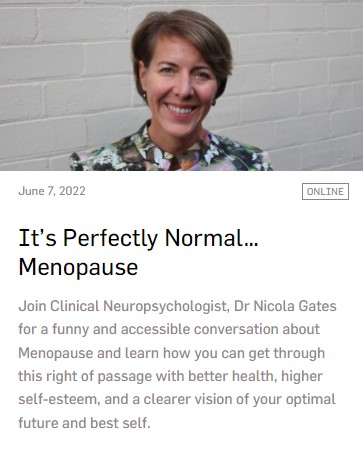
  • It’s perfectly normal… menopause

    The Ipswich Library hosted an information session about menopause last night and I decided it would be a good opportunity to learn more about what to expect. There were about 50 of us who attended this online session on Zoom. Co-host Lissie Turner (a former Triple J radio announcer) instantly caught my interest when she mentioned having to pre-write and read out her introduction for the session, because of the brain fog she was experiencing at this time-of-life. I too have been getting a lot of this brain fog, but thought it was related to my iron deficiency (which has been treated by multiple iron infusions).

    The main part of the session was presented by health practitioner / researcher Dr Nicola Gates, who wrote The Feel Good Guide to Menopause. Nicola shared her personal story as a cancer survivor who had to have all her ‘woman parts’ surgically removed. Overnight she began to experience horrible hot flushes – several of them an hour – about five years ahead of the normal age for women to start menopause.

    Nicola shared lots of interesting points:

    • Women are born with all the eggs they will produce during their lifetime, and all foetuses are genetically female, until the Y-chromosome emerges (from insemination) to develop the male characteristics.
    • Women generally weren’t included in medical research until the 1990’s – our more complicated endocrine systems a probable factor. However it is now compulsory to include females in medical studies.
    • We go through the peri-menopause stage, which is when all the disruptive symptoms occur – the hot flushes, brain fog. When there has been no menstruation for at least 12 months, you are considered to be in menopause when your body is no longer producing hormones to the same extent (there is still some oestrogen production from adipose – fat cells). Post menopause is whenever you think you’re over it!
    • Hormonal changes affect decision making – not a good time to make life-changing decisions. The quality of your relationships will impact the quality of your menopause. Our oxytocin levels are boosted by safe relationships – big (six second) hugs make us feel better and increase our immune systems.
    • Menopause might trigger mental health issues if these have been experienced earlier in life. Confidence goes down, stress and anxiety go up – but studies show women are just as capable as ever, there is no deterioration in mental ability.
    • On the plus side, menopause liberates us from hormone-driven behaviours such as the compulsion to say yes everytime we are asked to take something on!

    Important advice for women in menopause:

    • It is important to continue all the things that good health requires, but at a gentler pace – healthy diet, gentle exercise. Yoga, walking and weight training are good options.
    • Also should do things that bring us joy – start your day with an attitude of loving kindness, give yourself a big smile in the bathroom mirror – guaranteed to get a big smile back 🙂
    • Pay mindful attention to your mind – get into the ‘NACK’ mindset – Non-judging, Acceptance, Curiousity, Kindness
    • Learn to dance to your own song – you are 50 – 60% of the way through this remarkable journey called life – it’s time to celebrate individuality and embrace your own uniqueness.

    We had opportunity to ask questions after the presentation. I asked if symptoms varied between women, for instance could one experience lots of brain fog, but no hot flushes? I was kindly told yes, there is lots of variation between women and we could even have different experience from our own mothers and grandmothers. Lissie mentioned Nicola’s book has lots of case studies showing different experiences by women in menopause – I may even check it out.

    Overall a very positive and reassuring outlook for the years ahead. And there will be more hugs to Jo and Mum (COVID virus notwithstanding).

    Photo by Birmingham Museums Trust – The Travelling Companions is an 1862 oil-on-canvas painting by British artist Augustus Leopold Egg. Sometimes interpreted as representing two sides of the one person, it could be me and Jo – I am the one napping, Jo is the one reading!

  • The art of communicating

    Thich Nhat Hahn was a Vietnamese Buddhist monk and author. His book, The Art of Communicating was published in 2014. I started listening to it as an audiobook last night.

    The first chapter is so beautiful. Communication can nurture or toxify. The act of writing a compassionate letter or email (without even sending it) has a nurturing effect on us. We can ‘water the flowers’ and nurture others by speaking with kindness and compassion. The internet contains much that is toxic. We are connected by mobile technology yet we have never been so alone. We can re-centre by sitting away from the phone and the computer, communicate with our essential self by focusing mindfully on the breath.

    I am familiar with mindfulness therapy but do not regularly practice focusing on the breath, this book reminded me. I nodded off during the second chapter and had a wonderful sleep. I awoke the next morning feeling quite joyful.

    ‘There is a saying in Vietnamese, ‘It doesn’t cost anything to have loving speech.’ We only need to choose our words carefully, and we can make other people happy. To use words mindfully, with loving kindness, is to practice generosity. We can make many people happy just by practicing loving speech.’

    – Thich Nhat Hanh

    There is a review of the book here – plumvillage.com

  • Election work

    It was with a sense of the freedom I now have as an out-of-work student that I signed up to work for the Australian Electoral Commission (AEC) on the Federal election held a couple of weeks ago. After submitting an application from the AEC web site I received a phone call within a couple of days and was offered work at a pre-polling station in the fortnight leading to election day. I opted instead to work on election day only (May 21) since I didn’t want to divert time away from my studies. I was one of 100,000 temporary workers, in what is Australia’s biggest peace-time operation. Overall I felt it was a really good experience, one that I would be willing to repeat. I felt quite engaged with our democratic process, perhaps for the first time in my life.

    AEC’s onboarding process was almost entirely based online in the AEC Employment portal. It was where we had to lodge our employment paperwork – tax file number, superannuation, bank details, and signed employment contract. The AEC portal was also where we had to complete the required training modules. These were easy to follow and each had a quiz at the end. In my role as polling assistant the training covered the tasks of ordinary vote issuing officer, ballot box guard, queue controller and (thanks to COVID-19) hygiene officer. We were also sent an election procedure handbook by mail which we were required to read and a few days before election day, I was phoned by the poll supervisor (Dana) to check if there were any issues or questions.

    The important ‘election delivery principles’ stressed in the training were

    • integrity of the result
    • efficient processes and procedures, and
    • good customer service

    Integrity of the result had priority over all other considerations – for instance, if a voter accidently dropped a personal item into the ballot box, we were not permitted to open the ballot box to retrieve it for them. They would have had to return later after the boxes had been opened for counting. It is apparent that integrity of the result has a heavy influence on the rather old-fashioned, manual process of counting ballot papers. One of the instructions for counting included ‘banding’ of ballot papers into groups of 50 with a rubber band – it took me back to my old days as a bank teller. I suppose that computer systems are not yet sufficiently trusted to deliver an indisputable election outcome.

    Election day started early – my shift started at 7am and even though I arrived early at the school hall, it was already a hive of activity and the polling booths had been set up. There were three other people like me who had not worked at an election before, and four people with election experience. I gathered that a couple of them had ordinary ‘day jobs’ at the school. Voters began arriving from 8am and as the day progressed we rotated into the various duties. I started as a queue controller, did a stint as ballot box guard and for the remainder of the time was at the ballot issuing table. This required us to locate and tick off voters from the electoral roll for our electorate (similar in size to a small telephone directory), and give instructions on how to fill out their ballot papers, which we had to initial before handing out. If someone made a mistake, we gave them new ballot papers and had to put the ‘spoilt’ papers in a sealed envelope for the ballot reconciliation at the end of the day. I was briefly pulled off the ordinary ballot table and shown the declaration voting process (for voters not registered in the local electorate), entailing a few extra steps – not part of the job I was hired for, but offered more experience for the next election.

    The work wasn’t too difficult, and I enjoyed the interaction with the other workers, we got to know each other a little through the course of the day. Finding names on the electoral roll was a little difficult physically, with my face mask and spectacles that kept fogging up. My favourite part of the work was the ballot sorting and counting after 6pm. The boxes were ceremoniously opened in front of a scrutineer and the contents tipped out onto a table. We then dived in and manually sorted according to the primary vote in the first sweep, then second preference for those candidates who received the fewest votes. We started with the House of Representatives ballots, then the Senate papers. It was a long day – we finished up a little before 10pm, which was early according to Dana.

    An unexpected benefit of the experience, I learned firsthand the logic behind the so called two-party preferred system we have in Australia. Each ballot must number the different candidates in order of preference, otherwise it is not counted. A lot of people dislike this system because they believe the election outcome should be based on the primary vote (number one candidate only) and they complain that the system favours the two major parties. However it only does this to the extent that the major parties are supported in their electorate. If the (hypothetical) Lunatic Fringe Party received 30% as the highest proportion of primary votes in an electorate, this would not be a desirable outcome to a remaining 70% who marked the party at the bottom of their preferences. The preference system is about electing the least objectionable candidate to the majority of voters in an electorate.

    Photo by Glen Carrie on Unsplash